Over the past few years, blockchain has gone through a cycle that is all too familiar in technology.
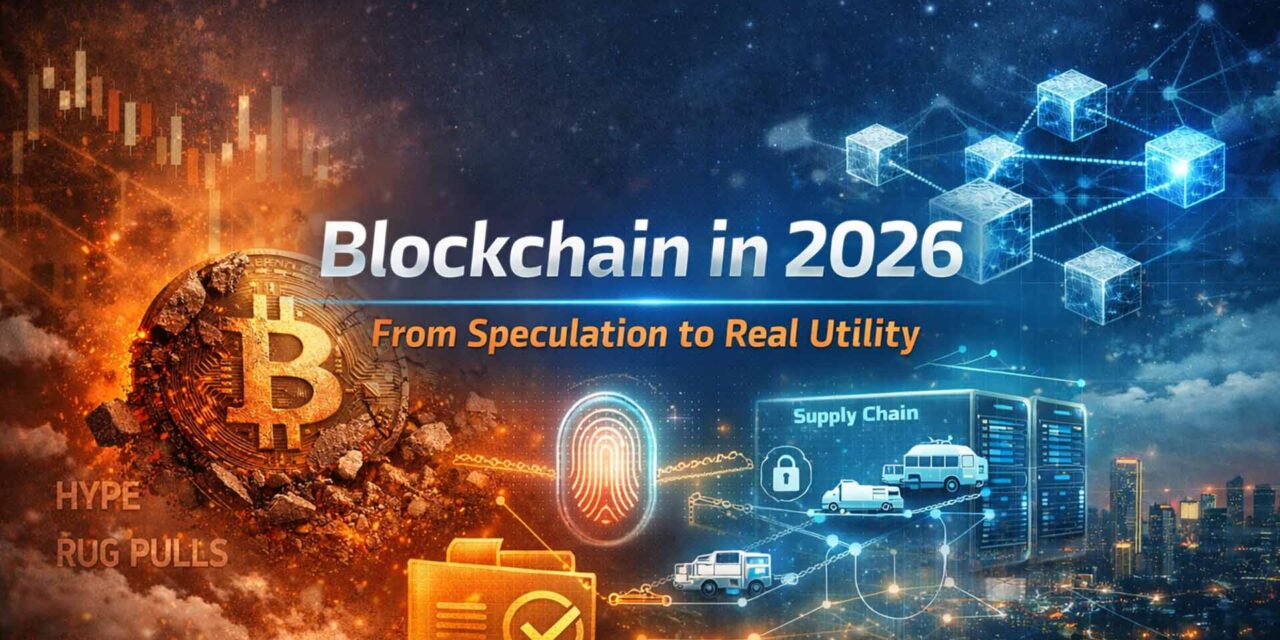
Hype. Explosion. Abuse. Collapse.
By 2026, the industry has reached a point where many people have lost trust. Rug pulls, failed NFT projects, unsustainable DeFi platforms, and speculative tokens have damaged the credibility of what was once seen as a revolutionary technology.
But here is the truth.
Blockchain did not fail. Speculation failed.
What remains today is something far more valuable than hype.
What remains is utility.
1. The Shift: From Visible to Invisible Blockchain
One of the biggest realizations in recent years is that blockchain does not need to be visible to users.
In fact, the most powerful implementations are the ones users never notice.
The future of blockchain is not in flashy interfaces or token dashboards. It lies in becoming invisible, integrated, and deeply embedded into systems as infrastructure. A quiet trust layer that operates in the background, ensuring that data remains authentic, systems remain reliable, and processes remain verifiable.
Users do not need to understand blockchain. They only need to trust the system.
This mirrors how the internet evolved. No one thinks about underlying protocols when browsing a website. In the same way, blockchain will eventually disappear into the background.
When users stop talking about blockchain, that is when it has truly succeeded.
2. The Real Problem Blockchain Solves
At its core, blockchain solves one thing exceptionally well.
Trust.
Not financial speculation. Not trading. Not digital collectibles.
Trust.
In today’s systems, trust is often assumed rather than proven. Logs can be edited, data can be overwritten, systems can be compromised, and audit trails can be manipulated.
Blockchain introduces a different model. Instead of asking users to trust the system, it allows them to verify it.
Through immutability, cryptographic verification, decentralized validation, and traceability across time, blockchain provides guarantees that traditional systems struggle to offer.
It transforms systems from “trust me” into “verify me.”
3. Real World Use Cases That Matter
3.1. Tamper-Proof Data and Audit Trails
In enterprise environments, especially in high-stakes systems such as infrastructure, finance, and industrial platforms, data integrity is not just important; it is critical.
A single altered log can impact investigations, invalidate insurance claims, or lead to compliance issues. Traditional systems rely on centralized databases, which can be modified either intentionally or unintentionally.
Blockchain changes the nature of logs. Instead of being editable records, they become immutable evidence.
Each event can be hashed, timestamped, and recorded in a way that links it to previous records. Even if the original data is stored off-chain, any modification will immediately break the integrity check.
For example, in a monitoring or incident management system, events such as alerts, system actions, or captured data can be recorded and verified using blockchain. Each record can be traced back to its origin and validated independently, ensuring that no changes have been made after the fact.
This becomes particularly valuable in environments where accountability and traceability are required, such as regulatory reporting, internal audits, and incident investigations.
In practice, logs are no longer just records.
They become provable, tamper-resistant evidence.
3.2. Trust Layer for Artificial Intelligence
Artificial Intelligence is advancing rapidly, but it introduces a critical question.
Can we trust the output?
AI systems are often opaque. Results can vary depending on model versions, training data, and input conditions. Without proper tracking, it becomes difficult to verify whether an output is authentic or has been altered.
Blockchain can act as a verification layer for AI systems by recording model versions, hashing inputs and outputs, and timestamping inference events.
This creates traceability.
It allows systems to prove not only what the output is, but how it was generated. In environments such as security systems, medical diagnostics, and automated decision-making, this level of accountability is essential.
Blockchain does not replace AI.
It strengthens it.
3.3. Supply Chain Transparency
Supply chains are inherently complex and often lack transparency. Data is fragmented across multiple stakeholders, making verification difficult.
Blockchain enables a shared, tamper-resistant record of events across the entire chain.
From origin to delivery, each step can be recorded and verified. For example, in a coffee business, products can be tracked from farm to roasting, through distribution, and finally to the customer. Each stage adds a verifiable checkpoint.
This is not just about marketing transparency. It enables authenticity verification, fraud prevention, quality tracking, and efficient recall processes.
Transparency becomes more than a feature.
It becomes a competitive advantage.
3.4. Digital Identity and Access Systems
Identity systems today are often centralized and fragmented, making them vulnerable to duplication, misuse, and breaches.
Blockchain enables a decentralized approach to identity, where each entity has a unique cryptographic identity that can be verified without exposing unnecessary data.
This allows identities to be portable across systems while maintaining security and privacy.
In practical terms, this can be applied to employee access systems, customer identity across multiple business branches, and loyalty platforms.
Instead of relying on a central authority, identity becomes something that can be independently verified.
3.5. Document Verification and Notarization
One of the most practical applications of blockchain is document integrity.
Instead of storing documents directly on-chain, systems can store a cryptographic hash along with a timestamp. This allows any document to be verified at a later time by simply recomputing its hash and comparing it with the recorded value.
If they match, the document is authentic.
This approach can be applied to contracts, invoices, certificates, and legal documents. It reduces reliance on third-party verification and simplifies dispute resolution.
In a business context, this means that documents are no longer just stored.
They are provably unchanged.
3.6. Device and IoT Trust Networks
Modern systems rely heavily on interconnected devices, yet one of the biggest challenges remains unchanged.
Can the system truly trust the device?
Devices can be spoofed, compromised, or impersonated. This introduces significant risk, especially in systems that rely on real-time data.
Blockchain introduces device-level trust by assigning each device a unique cryptographic identity. Data generated by the device can be signed and verified, ensuring authenticity.
For example, when a device captures data, that data can be signed and recorded with a corresponding hash. This ensures that the data is authentic, the source is verifiable, and any tampering is detectable.
This is particularly important in surveillance, industrial systems, and smart infrastructure.
Trust shifts from assumptions to proof.
4. Kooaia Network and a Personal Reflection
Several years ago, I started working on a blockchain project called Kooaia Network.
The intention was not to create another token-driven platform. It was to build a foundation, a trust layer that could support the systems I was building.
However, as the blockchain space became saturated with rug pulls and hype-driven projects, the environment shifted. The conversation moved away from engineering and toward speculation.
At the same time, the industry began shifting heavily toward Artificial Intelligence. Like many others, I explored this space and started personal projects. However, due to personal priorities, both AI and blockchain initiatives, including Kooaia Network, went into hiatus.
Stepping back was necessary.
4.1. A Reassessment, Not an Abandonment
Looking at the space today, one thing becomes clear.
The original vision still holds.
Kooaia Network was never meant to compete in crowded or hype-driven markets. It was always intended to serve as a supporting layer.
Instead of positioning it as a standalone platform, it makes more sense to think of it as part of a larger system.
A possible direction is for it to evolve into a backend trust layer that supports enterprise systems, SaaS platforms, business applications, data verification workflows, and even government or public sector initiatives where data integrity matters.
At this stage, it is less about defining exactly what it should become and more about understanding where it naturally fits.
Not as the product itself, but as something that strengthens other systems.
4.2. Revisiting What Matters
My current role in a Singapore-based technology company does not conflict, contradict, or compete with my personal initiatives in Blockchain and Artificial Intelligence.
This provides clarity.
It also creates an opportunity.
Perhaps it is time to revisit these areas, not from a perspective of hype, but from a perspective of purpose, if the right opportunity comes.
With clearer direction and real-world experience, the approach moving forward can be more focused, more disciplined, and more practical.
Not chasing trends.
But building systems that solve real problems, integrate into real workflows, and deliver measurable value.
Kooaia Network and AI initiatives can evolve naturally as part of a broader ecosystem, grounded in real use cases rather than driven by market noise.
4.3. Looking Forward
The goal is no longer visibility.
The goal is longevity.
To build systems that operate quietly in the background, provide trust without friction, and scale across multiple applications.
This is where Blockchain and AI converge.
Not as buzzwords.
But as infrastructure.
Not seen, but essential.
5. Final Thoughts
Blockchain in 2026 is no longer about making noise.
It is about making sense.
The future belongs to systems that are:
- Trustworthy
- Verifiable
- Integrated
Blockchain will not disappear.
It will simply become invisible.
And when it does,
that is when it truly succeeds.