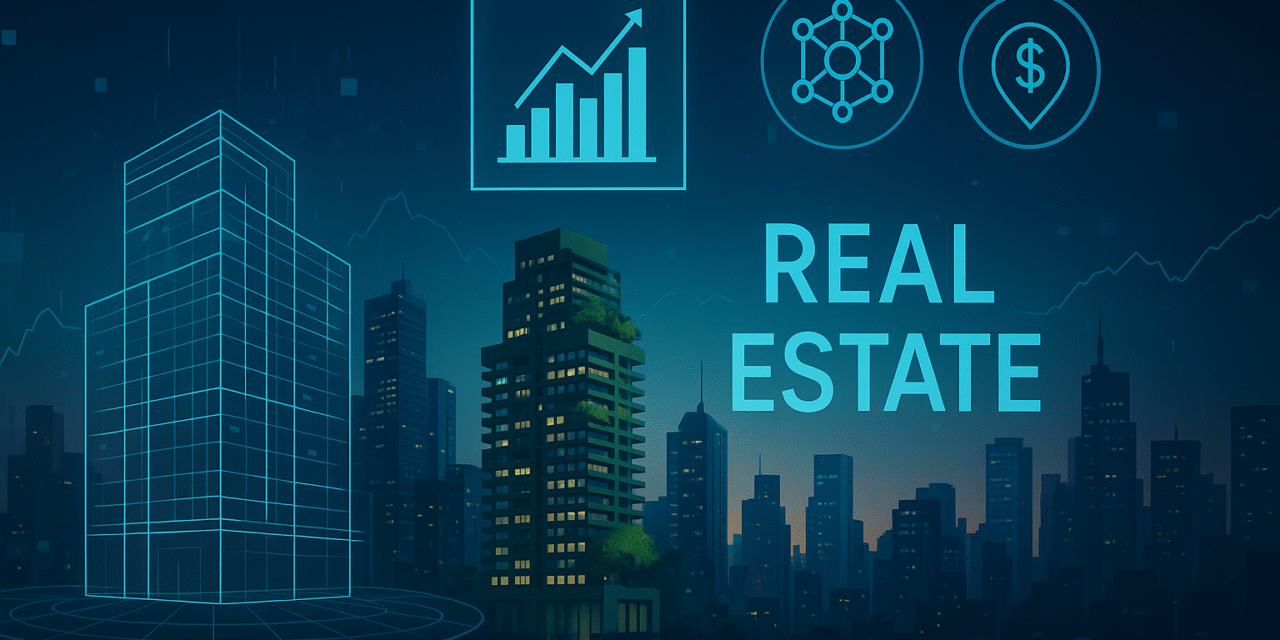
The real estate industry, long seen as steady, slow-moving, and anchored in “how things have always been done”, is in the midst of a transformation. In the next decade (maybe even the next few years), what used to be brick-and-mortar, paper-based systems will increasingly be digital, automated, and data-driven.
Technology isn’t just a tool in real estate’s evolution; it’s the driver. Below is a deeper dive into how AI, blockchain, sustainability, immersive experiences, and supporting trends are converging to rewrite how people purchase, manage, and invest in property.
1. Smarter Valuation & Market Intelligence: AI at the Core
1.1. From Heuristics to Models
Traditional property valuation relies heavily on comparable sales, local knowledge, and human judgment. But now, advanced models are combining spatial data, imagery, macroeconomic trends, neighborhood “sentiment,” and even climate projections to produce valuations and forecasts.
- In research, vision-transformer models (computer vision + deep learning) have been applied to property photos, street views, and structural images to improve valuation precision beyond what human appraisers can do alone. (arXiv)
- More broadly, real estate service firms see AI as a transformational shift. For example, 89% of C-suite executives believe AI can help solve major commercial real estate challenges. (JLL)
- As appraisals standardize (for instance, the move toward more machine-readable forms in regulations), AI-led valuation frameworks will more seamlessly integrate into institutional workflows. (arXiv)
1.2. Use Cases: Predictive & Autonomous
- Predictive analytics: AI models forecast which neighborhoods or property types will appreciate fastest, helping investors get ahead of the curve.
- Automated Valuation Models (AVMs): Many property platforms already use AVMs for quick estimates; the next wave is “explainable AVMs” that can justify why a valuation was made.
- Smart risk scoring: Factor in climate risk, flood zones, infrastructure developments, or regulatory changes, not just current comparable sales.
1.3. Challenges & Ethical Considerations
- Bias & fairness: Training data must be carefully curated; otherwise, algorithms amplify systemic biases (against certain neighborhoods, demographics, etc.).
- Explainability: Stakeholders may demand not just “a number,” but why the number was given (especially in legal or financial contexts).
- Regulation & compliance: In markets like the EU/UK, AI use must navigate data protection laws (e.g., GDPR) and evolving AI regulations. (McDermott)
2. Tokenization & Fractional Ownership: Democratizing Real Estate Access
One of the most radical shifts is turning real estate into liquid, tradable, and divisible assets through blockchain and smart contracts. This opens property investment to a far wider class of participants and reshapes how capital flows into real estate.
2.1. What is Tokenization?
- A real-world asset (RWA) is “tokenized” when its ownership rights are tied to digital tokens on a blockchain. Those tokens can then be bought, sold, or held. (Wikipedia / Wikipedia)
- Proper tokenization includes legal backing, auditability, and secure bridges between the off-chain (actual property) and on-chain (token) worlds.
2.2. Why it Matters
- Liquidity: Illiquid assets like buildings or land become tradable in secondary markets.
- Fractional ownership: Instead of needing full capital to buy a property, investors can own small shares.
- Transparency & trust: Blockchain’s immutable ledger reduces fraud risk and helps with clear proof of ownership.
- Efficiency in transactions: Smart contracts automate transfer of ownership, escrow, payments, and more, reducing intermediaries and delays. (proprli / ScienceDirect)
2.3. Real Examples & Movement
- DAMAC (Dubai) signed a $1B deal to tokenize real estate assets via the MANTRA blockchain. (Reuters)
- Seazen (China) is exploring converting property & income streams to digital tokens to provide liquidity in a tight real estate market. (Reuters)
- Elevated Returns / Stephane de Baets pioneered tokenization efforts, including fractionalizing luxury real estate in the U.S. via blockchain. (Wikipedia)
2.4. Risks & Hurdles to Overcome
- Regulatory clarity: Tokenization straddles real estate law, securities law, and digital asset regulation.
- Valuation and audit mechanisms: How do you validate that a token truly represents value/ownership?
- Market adoption & education: Buyers, regulators, lawyers, and financial institutions must adapt to this mental model.
- Security & custody: Safeguarding tokens and underlying assets is critical to avoid hacks or fraud.
3. Sustainability & Climate Resilience as Value Drivers
Environmental concerns are no longer optional; they’re integral to how real estate will be bought, developed, and valued.
3.1. Green Premium & ESG Metrics
- Properties with energy-efficient systems, solar panels, green certifications (e.g. LEED, BREEAM), and low carbon footprints are commanding higher valuations and stronger demand.
- The “green premium” isn’t just theoretical; tenants and investors increasingly prefer buildings with lower operating costs, better indoor environments, and regulatory clarity on emissions.
3.2. Smart Buildings & IoT Integration
- Buildings are getting sensors: smart HVAC, lighting, water usage, leak detection, occupancy, and security systems that feed data to AI. (RealCube / proprli / Luxury Presence)
- These systems enable predictive maintenance (fix before breakdown), efficiency optimizations, and insight-driven cost savings. (Andrew Busch / proprli)
3.3. Climate Risk & Location Strategy
- Climate change (flooding, sea level rise, heat stress, storms) now factors into site desirability and long-term resilience.
- Some tech firms analyze climate risk overlayed with real estate data to guide where to invest next. (E.g., mapping where climate impacts will make or break property value in decades.) (Axios)
3.4. Policy, Incentives & Mandates
- Governments are tightening building codes, mandating emissions targets, offering tax breaks for green buildings, and requiring disclosures (especially in developed markets).
- Real estate players who get ahead of regulation will have a competitive edge.
4. Discovery, Experience & Transaction Platforms: The New Interface
The way we search, view, negotiate, and finalize real estate deals is rapidly evolving. It’s shifting from static listings + agent interactions to AI-first, immersive, conversational platforms.
4.1. Conversational & Generative Interfaces
- Instead of scanning listings, buyers may describe what they want (“3BR, close to transit, north-facing, with garden”) and AI agents will propose matches, simulate modifications, and negotiate.
- Generative models can generate visuals of interior designs, floor plan tweaks, or remodel variants on the fly.
4.2. VR, AR & Immersive Tours
4.3. Streamlined, Digital Transactions
- Platforms are embedding smart contract logic to support click-to-buy, automated escrow, integrated identity verification, and instant title transfers.
- Self-Sovereign Identity (SSI) models + blockchain-based property records can counter fraud and streamline verification. (arXiv)
4.4. Data-Driven Matching & Personalization
- Property platforms will leverage big data and AI to not just show houses, but predict what’s ideal, match to buyer personality, and dynamically tailor search filters.
- Sellers will receive insight-driven pricing recommendations, buyer personas, optimal staging suggestions, and marketing automation.
5. Supporting Trends & Macro Forces to Watch
Beyond the “big four,” several intertwined forces will accelerate or constrain how this future unfolds.
5.1. PropTech Investment & Ecosystem
- Firms like Fifth Wall specialize in investing in real estate + tech (PropTech), bridging capital and innovation. (Wikipedia)
- The pace of startup innovation in real estate is increasing, making partnerships between traditional realty firms and tech players essential.
5.2. Data Infrastructure & Interoperability
- For all AI, tokenization, and immersive systems to work, data standards, APIs, and interoperability across platforms (title registries, zoning databases, tax systems) must mature.
5.3. Legal, Compliance & Regulation
- Real estate is heavily regulated, including land use, zoning, property law, and consumer protection. Any tech solution must fit within these frameworks.
- Privacy laws, AI regulation, crypto/digital asset regulation, these all intersect and could slow adoption if not harmonized.
5.4. Behavioral & Trust Barriers
- Real estate is personal and emotional. Buyers often want human reassurance, inspection, negotiation. Tech must augment, not replace, trust relationships.
- Adoption curves differ by market. In many regions, people prefer “seeing with their own eyes” and working with known agents.
5.5. Economic Cycle & Interest Rates
- Real estate will still respond to macro factors: interest rates, liquidity, inflation, supply/demand imbalances. Technology can help mitigate some risks but not eliminate them.
6. What This Means for Stakeholders
6.1. For Buyers & Investors
- More transparency, faster transactions, lower barriers to entry (especially via fractional models).
- Expect more tools and analytics to help assess and compare properties with deeper insight (risk, value, climate, growth potential).
- You’ll have more options, but also more information overload. Choosing trusted platforms will matter.
6.2. For Developers & Sellers
- Early adoption of green features, smart systems, and tokenization-ready designs will become a differentiator.
- Integrating with digital transaction platforms, building in sensor infrastructure, and designing for flexibility are key.
6.3. For Brokers & Agents
- Agents who resist technology risk being disintermediated. Those who adopt AI, data platforms, and immersive tools will stand out.
- Your role may shift: from gatekeeper to curator, advisor, experience-builder, and “platform integrator.”
- Upskilling in tech, data, and digital tools becomes essential.
6.4. For Governments & Regulators
- Updating property registries, legal frameworks, and consumer protections for digital transactions and tokenized ownership.
- Balancing innovation with consumer safety (fraud, privacy, fairness).
- Facilitating digital infrastructure (e.g. land title databases, geospatial systems, zoning APIs).
7. A Vision of How It Could Work: A Use Case
Imagine this:
- You log into YourRealtyX, an AI-powered real estate platform.
- Using a chat or “describe your dream home” prompt, you say: “I want a 3-bedroom home near good schools, with natural light, walkable to shops, that’s climate-resilient.”
- The system brings up 5-8 candidate properties, with AI-generated projections on value, rental potential, climate risk, and green upgrade costs.
- You “visit” one property via an immersive VR walkthrough, toggling “show me with solar roof” or “remove this wall” in AR.
- You decide to buy 20% fractional ownership through tokens issued on a blockchain. The smart contract handles escrow, title registration, and recurring maintenance contributions.
- For property management, an AI + IoT system monitors energy, HVAC, security, schedules maintenance, and alerts you (and other fractional owners) transparently.
- Over time, as the area improves, the AI revalues your share, and you can trade your tokens on a secondary marketplace, all seamlessly.
That’s not sci-fi. That’s a plausible near-future, especially in tech-forward markets.
Contents
- 1. Smarter Valuation & Market Intelligence: AI at the Core
- 2. Tokenization & Fractional Ownership: Democratizing Real Estate Access
- 3. Sustainability & Climate Resilience as Value Drivers
- 4. Discovery, Experience & Transaction Platforms: The New Interface
- 5. Supporting Trends & Macro Forces to Watch
- 6. What This Means for Stakeholders
- 7. A Vision of How It Could Work: A Use Case