1. A World Buzzing About AI
Artificial Intelligence is everywhere, and not just in our devices, but in our conversations.
Every day, a new headline promises a revolution:
- “OpenAI releases GPT-5.”
- “Google integrates Gemini across Search.”
- “Apple brings on-device intelligence to iPhone.”
- “Meta unveils AI for creators.”
Governments are forming task forces. Startups are raising billions overnight. Social media is flooded with AI art, AI tools, AI job fears, and AI predictions.
In 2025, the AI race has become the new space race, a competition of scale, speed, and intelligence. But here’s what most people don’t realize:
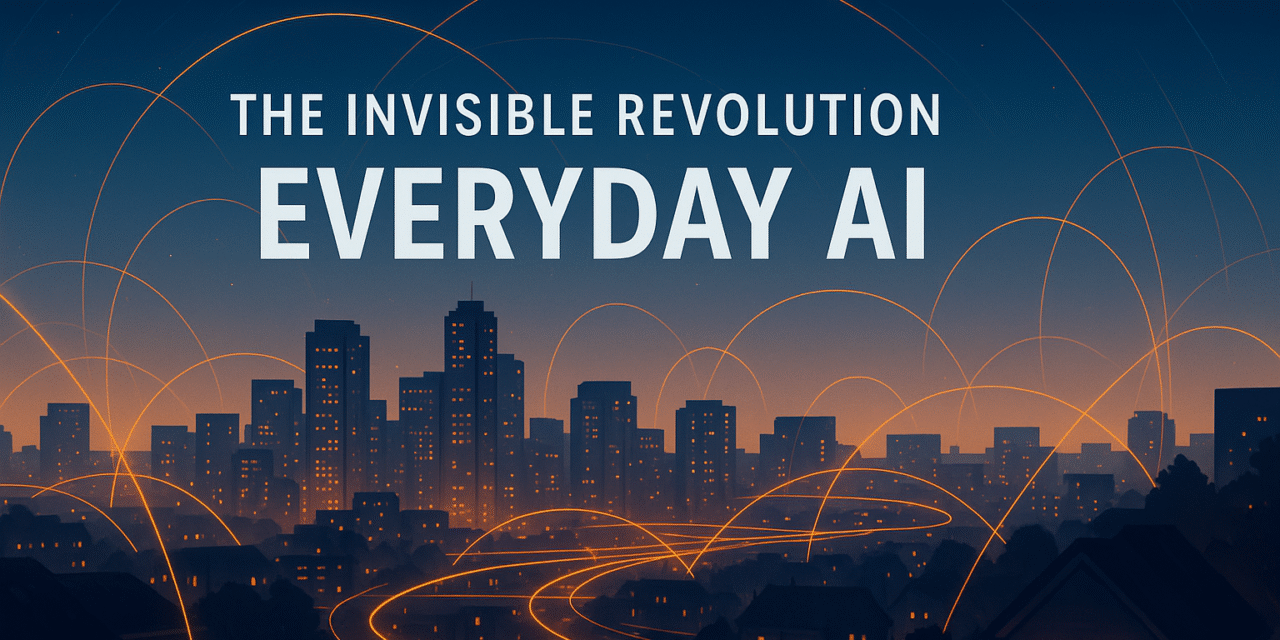
The true AI revolution isn’t the one making noise. It’s the one operating quietly in the background. It’s the algorithm that sorts your inbox before you open it, the route planner that avoids traffic before you even notice it, and the camera app that subtly enhances your photo without being asked.
While the world debates AI as an event, we’re already living inside AI as an environment.
That’s the paradox of this moment:
Artificial Intelligence has never been louder in conversation, or quieter in operation.
2. From the Spotlight to the Background
There was a time when AI was confined to science fiction and university labs.
The 1950s dreamed of thinking machines; the 1980s feared them. Then came the AI winters, long periods of stagnation caused by underwhelming results and overblown expectations.
But the 2010s changed everything. Massive datasets, affordable GPUs, and new deep-learning techniques revived AI’s promise. Suddenly, machines could recognize faces, translate languages, write coherent paragraphs, and generate images from text.
AI became not just useful, but it became everywhere.
As Deloitte’s Tech Trends 2025 report puts it,
“AI is no longer something organizations deploy, it’s something they depend on.”
(Source)
And that dependence has quietly shifted AI from front-stage to backstage, from novelty to necessity.
3. The Hidden Revolution
To understand how we got here, it helps to trace AI’s evolution through three overlapping eras:
3.1. The Age of Algorithms
In the beginning, AI was rule-based. Developers wrote logic manually: if this, then that. It worked for structured tasks but failed in complexity.
3.2. The Age of Learning
Then came machine learning. Instead of programming every rule, we fed machines vast datasets and let them learn from patterns. That transition from explicit instruction to implicit discovery changed everything.
3.3. The Age of Integration
Now we’re in the age of ambient intelligence, where AI no longer feels like a separate tool. It’s built into cameras, thermostats, chat apps, and operating systems. It doesn’t announce itself; it simply acts.
Mark Weiser, the pioneer of ubiquitous computing, foresaw this decades ago:
“The most profound technologies are those that disappear — they weave themselves into everyday life until they are indistinguishable from it.”
(Weiser, 1991)
AI has fulfilled that vision. The smarter it becomes, the less visible it needs to be.
4. Everyday AI: The Silent Engine of Modern Life
If you think you’re not using AI every day, think again. Here’s what’s happening quietly around you:
| DOMAIN | EVERYDAY EXAMPLE | HIDDEN AI TASK |
| Smartphones | Face unlock, portrait mode, battery optimization | Facial recognition, scene segmentation, and behavior prediction |
| Search & Feeds | Google results, YouTube & Spotify recommendations | Natural language understanding, reinforcement learning |
| Healthcare | Smartwatch ECG alerts, image-based diagnostics | Pattern recognition, anomaly detection |
| Transportation | Traffic rerouting, autopilot, ride-hailing | Sensor fusion, path inference |
| Retail | Personalized shopping, dynamic pricing | Recommendation systems, behavioral clustering |
| Smart Homes | Thermostat adjustment, lighting scenes | Contextual sensing, adaptive modeling |
| Work Productivity | Grammar correction, auto-summarization, code completion | Transformer-based inference, intent prediction |
According to the Stanford AI Index 2025, over 77% of digital consumer products already use some form of embedded AI, often running locally on your phone or wearable instead of in the cloud. (Stanford HAI 2025 AI Index Report)
That means AI is no longer “out there”, it’s with you, for you, and sometimes, ahead of you.
5. How AI Became Invisible
The invisibility of AI isn’t accidental; it’s the result of design evolution.
- Frictionless Interaction
Touch, voice, and predictive text have reduced the need for explicit commands. The less we type or click, the more natural it feels and the more invisible the intelligence becomes. - Distributed Intelligence
AI no longer lives in a single model. It’s distributed across millions of devices, each handling small, context-specific decisions, a model known as Pervasive AI. (arXiv:2105.01798) - Continuous Personalization
AI learns from every scroll, click, and pause. The more you use it, the more it adapts until its predictions feel indistinguishable from intuition. - Predictive Design
Your car cools the cabin before you get in. Your inbox filters distractions automatically. Your phone lowers its brightness as your eyes tire.
When intelligence aligns perfectly with behavior, we stop calling it AI; we just call it life working as expected.
6. Why We Can’t Live Without It
AI’s silent integration has made it indispensable.
We now rely on it not because we choose to, but because it’s built into the systems that define modern living.
- Efficiency – Reduces friction and cognitive load.
- Scalability – Enables businesses to operate 24/7 without adding manpower.
- Personalization – Delivers experiences that feel tailored and human.
- Decision Support – Offers data-driven insights that extend human judgment.
Invisible AI isn’t replacing human potential, it’s amplifying it, quietly and consistently.
7. The Unseen Costs of Invisibility
But progress always has a shadow.
The more invisible AI becomes, the harder it is to question, control, or even notice.
- Transparency and Explainability
When algorithms make decisions we can’t see, trust becomes fragile.
We need not only smarter AI, but explainable AI. - Bias and Fairness
Invisible systems may amplify invisible biases, deciding what news you read or which candidate gets hired. - Privacy and Surveillance
To personalize, AI must observe. To observe, it must collect.
Invisible data collection is still data collection, only harder to detect. - Environmental Cost
AI’s energy footprint is significant.
AP News reports that a single AI-powered search can use 10x more energy than a traditional one, multiplied by billions of queries daily. - Dependency and Skill Erosion
Navigation replaced map reading.
Autocomplete replaced spelling.
Recommendation replaced curiosity.
The more we automate, the less we practice.
There’s a growing discussion around what is called the paradox of convenience:
“The easier AI makes our lives, the more fragile we become without it.”
It’s a quiet truth of our time, each new layer of automation gives us freedom on the surface, but dependency underneath.
8. The Next Shift: AI as the World’s Operating System
The next decade won’t be about creating more AI, but about deeper integration.
8.1. Contextual Copilots
Personal AI agents that act before being asked, scheduling, recommending, or protecting you based on real-time context.
8.2. Augmented Environments
Smart spaces that overlay intelligence onto reality, offices that adjust lighting to focus levels, and cities that route traffic dynamically.
8.3. Ethical Intelligence by Design
AI must become auditable by design, embedding explainability, consent, and fairness into its architecture.
8.4. Democratization vs Monopoly
Will AI infrastructure be open and federated, or controlled by a few global ecosystems? The answer will define digital freedom for the next generation.
9. The Paradox of Progress
In the noise of AI hype, it’s easy to miss the quiet truth. The technologies that change the world most profoundly are the ones that stop calling attention to themselves.
Electricity once amazed the world. The Internet once felt magical. Now both are invisible necessities.
AI is crossing that same threshold from spectacle to expectation.
The future won’t be full of AI products shouting for attention. It will be defined by an AI infrastructure that simply works, silently, adaptively, and essentially.
10. Conclusion: The Quiet Power of the Unseen
Artificial Intelligence has reached its most transformative moment not by dazzling us, but by disappearing.
It powers the photo you share, the road you drive, the playlist you hear, and the message you’re about to send, all without fanfare.
This is not the rise of machines; it’s the rise of invisible cognition, an intelligence so deeply woven into daily life that we no longer notice it working.
The challenge ahead isn’t to make AI louder or smarter; it’s to make it responsible, accountable, and humane while it quietly powers the world beneath our fingertips.
Contents
- 1. A World Buzzing About AI
- 2. From the Spotlight to the Background
- 3. The Hidden Revolution
- 4. Everyday AI: The Silent Engine of Modern Life
- 5. How AI Became Invisible
- 6. Why We Can’t Live Without It
- 7. The Unseen Costs of Invisibility
- 8. The Next Shift: AI as the World’s Operating System
- 9. The Paradox of Progress
- 10. Conclusion: The Quiet Power of the Unseen