
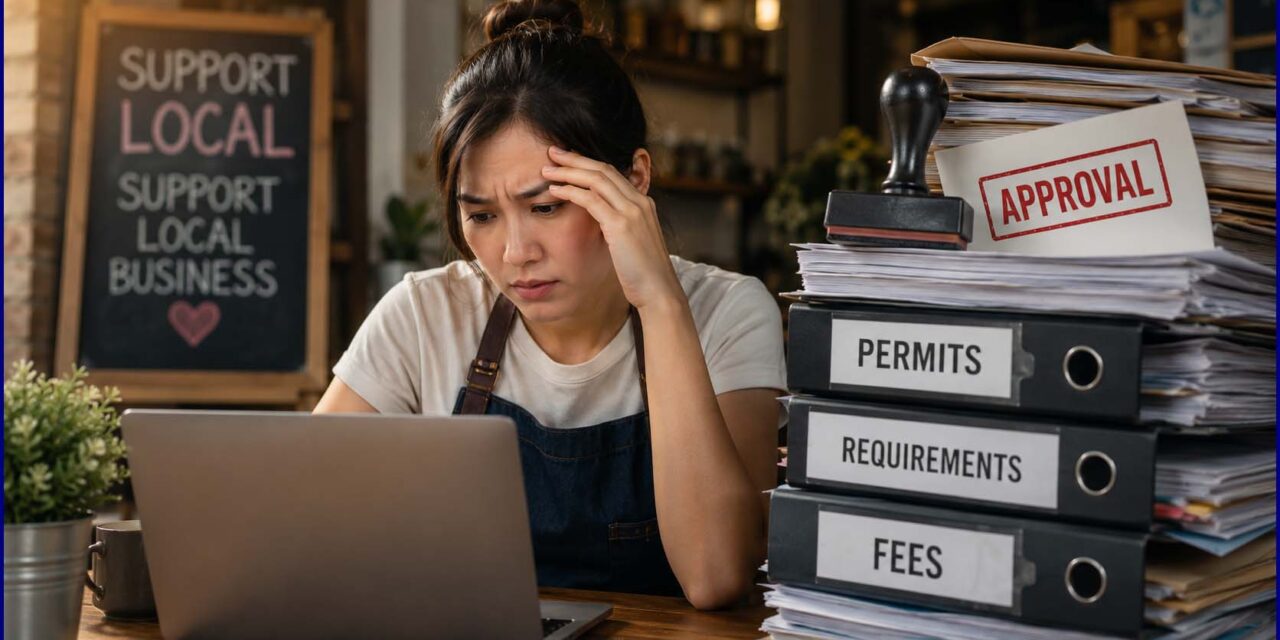
The Department of Trade and Industry (DTI) recently clarified that its proposed advertising permit requirement was merely an internal draft and would not be implemented. While many entrepreneurs welcomed this decision, the public response also highlighted what many view as a deeper issue facing Philippine businesses today. Many MSME owners feel that despite frequent calls to support local and encourage entrepreneurship, the combined weight of regulations, permit requirements, taxes, and compliance costs can make business growth more difficult than it ought to be.
The controversy surrounding the proposal was never simply about advertising permits. It highlighted a broader frustration that many entrepreneurs say they have felt for years. Across the country, business owners invest their savings, take financial risks, create employment opportunities, and contribute to local economies, yet many also feel they must navigate a growing maze of permits, compliance requirements, reporting obligations, and administrative procedures.
No responsible entrepreneur argues against consumer protection or fair regulation. Every legitimate business benefits when fraudulent operators are held accountable. However, many business owners question whether new regulations always achieve their intended objectives or whether they sometimes create unintended barriers for the very businesses that drive economic growth.
This discussion is particularly important because micro, small, and medium enterprises are not merely participants in the Philippine economy. They form its foundation. Any policy that affects MSMEs ultimately affects employment, investment, innovation, and economic opportunity across the country.
1. The Proposal That Sparked Public Concern
1.1. What the Draft Proposed
The draft proposal would have required businesses to secure an advertising permit before publishing advertisements, including online advertisements, sponsored social media posts, videos, billboards, and promotional campaigns.
Under the draft proposal:
- Advertisements would require approval before publication.
- Applications would need to be submitted at least 30 working days in advance.
- Supporting materials such as storyboards, scripts, layouts, and documentation would be required.
- Permit fees could range from hundreds to thousands of pesos, depending on the type of advertisement.
Although the DTI later clarified that the proposal was only an internal draft and would not be enforced, the proposal generated significant public discussion because of its potential impact on businesses operating in an increasingly digital and fast-moving economy.
1.2. Why the Public Reacted Strongly
The public reaction appeared immediate and widespread.
Entrepreneurs, online sellers, content creators, marketing professionals, and ordinary consumers expressed concern over what they perceived as an additional layer of bureaucracy. Many questioned whether a permit system designed around traditional advertising models was compatible with modern digital commerce.
In today’s environment, a business can create a promotional campaign in the morning and publish it in the afternoon. Online platforms allow businesses to respond quickly to customer demand, seasonal opportunities, market trends, and competitor activity.
The prospect of requiring government approval before publishing advertisements raised concerns about delays, administrative costs, and reduced competitiveness.
For many entrepreneurs, the proposal became symbolic of a larger issue. It reinforced the perception that while businesses are frequently encouraged to support economic growth, they are often required to navigate increasingly complex regulatory environments in order to do so.
2. Why Small Businesses Were Concerned
Large corporations often have dedicated legal teams, compliance officers, accountants, consultants, and marketing departments capable of managing regulatory requirements. Most MSMEs do not. For many small businesses, the owner performs multiple roles simultaneously, managing operations, finances, customer service, suppliers, employees, and marketing activities. In that environment, every additional requirement consumes valuable resources, and while large organizations can absorb extra compliance costs with relative ease, the same cannot always be said for small businesses operating with limited capital and manpower.
2.1. Business Moves Faster Than Government Processes
Modern commerce operates at remarkable speed. A local café may launch a special beverage for Mother’s Day, an online seller may join a weekend shopping festival, a retailer may need to clear inventory before new stock arrives, and a restaurant may introduce a limited time menu item based on seasonal demand. These decisions are frequently made within days, and the digital economy rewards businesses that can quickly identify opportunities and respond to changing consumer preferences. A lengthy approval process can therefore create a disconnect between regulatory timelines and commercial realities.
Imagine a small business discovering a new market trend. By the time approvals are completed, competitors may have already captured the opportunity, consumer interest may have shifted elsewhere, and the business may have lost both momentum and potential revenue. For many MSMEs, responsiveness is not merely an advantage; it is essential for survival. Large corporations often possess the resources to plan marketing campaigns months in advance, but smaller businesses typically do not have that luxury. Their success frequently depends on adaptability and speed.
2.2. Additional Costs Hurt MSMEs the Most
Every business faces expenses. Rent must be paid, utilities must be covered, employees must receive salaries, suppliers must be compensated, equipment must be maintained, and inventory must be replenished. For many MSMEs, profit margins are already narrow.
Additional permit fees, compliance costs, consulting expenses, and administrative requirements may appear manageable individually. However, their cumulative impact can be significant.
A few thousand pesos may not substantially affect a large corporation. For a small business, that same amount could represent inventory purchases, marketing expenditures, equipment upgrades, or employee incentives.
Entrepreneurs constantly make decisions about how to allocate limited resources, whether to invest in growth, improve customer experience, hire additional staff, or expand operations. Every peso directed toward compliance is a peso unavailable for productive investment.
The concern is not necessarily the size of a particular fee. It is the accumulation of multiple costs over time.
When combined with existing obligations, even relatively small additional expenses can become meaningful barriers to growth.
2.3. More Paperwork Means Less Productivity
Entrepreneurs generally start businesses to solve problems, create value, serve customers, and generate income. They do not typically enter business because they enjoy administrative paperwork, yet compliance obligations often require significant time and effort.
Business owners may be responsible for:
- Permit applications
- License renewals
- Regulatory reporting
- Tax documentation
- Employee records
- Government submissions
- Audit preparation
Each requirement may serve a legitimate purpose, but the challenge arises when these requirements accumulate. Time is one of the most valuable resources available to entrepreneurs, and every hour spent processing paperwork is an hour not spent improving products, engaging customers, training employees, exploring new markets, or developing innovative services. Large organizations can assign these responsibilities to specialized departments; small businesses often cannot. For many MSMEs, the owner personally handles much of the administrative workload.
The hidden cost of excessive bureaucracy is therefore not only financial. It also includes lost productivity, reduced innovation, and slower business development.
3. MSME Are the Foundation of the Philippine Economy
The importance of MSMEs cannot be overstated. Across the Philippines, MSMEs account for the overwhelming majority of business establishments and generate a substantial share of national employment.
These enterprises include:
- Family-owned stores
- Local restaurants
- Cafés
- Repair shops
- Manufacturers
- Service providers
- Online sellers
- Professional practices
- Startups
Collectively, they form the backbone of economic activity in communities throughout the country.
3.1. The Numbers Behind MSMEs
MSMEs represent approximately 99.5 percent of registered business establishments in the Philippines and generate more than 62 percent of total employment nationwide.
These figures illustrate an important reality: when policymakers discuss supporting businesses, they are primarily discussing MSMEs.
The vast majority of entrepreneurs are not operating multinational corporations or publicly listed companies. They are managing small enterprises with limited resources and significant personal financial risk.
Every regulation affecting MSMEs, therefore, affects a large portion of the national economy.
When MSMEs succeed, employment increases; when they expand, investment grows; and when they innovate, communities benefit.
Conversely, when MSMEs struggle, the consequences are felt not only by business owners but also by employees, suppliers, customers, and local economies.
This is why policies affecting small businesses deserve careful consideration. Their impact extends far beyond individual enterprises and influences broader economic development throughout the country.
3.2. Job Creation and Community Development
MSMEs create employment opportunities where they are needed most. A new café may hire baristas, cooks, cashiers, and delivery personnel; a repair shop may employ technicians and administrative staff; and a local manufacturer may create jobs for production workers, supervisors, and logistics personnel. The economic benefits extend beyond direct employment, because employees spend their income locally, suppliers receive additional business, landlords earn rental income, transportation providers gain customers, and economic activity spreads throughout the community.
This multiplier effect is one reason why supporting entrepreneurship is often viewed as one of the most effective methods for promoting inclusive economic growth.
Unlike large investment projects that may be concentrated in major urban centers, MSMEs distribute opportunities throughout cities, municipalities, and barangays across the country.
They help create local prosperity and reduce economic concentration.
3.3. Why MSMEs Matter During Economic Downturns
Economic uncertainty affects businesses of all sizes. However, MSMEs often demonstrate remarkable resilience because of their flexibility and adaptability. They can modify products, adjust operations, explore new markets, and respond quickly to changing conditions.
During challenging economic periods, many communities depend heavily on local businesses to sustain employment and economic activity.
A diverse MSME sector contributes to economic resilience by ensuring that opportunities are distributed across multiple industries and geographic locations rather than concentrated within a small number of large enterprises.
Countries with strong MSME sectors often recover more quickly from economic disruptions because entrepreneurial activity continues generating opportunities even when larger industries experience slowdowns.
4. Filling the Gaps Left by Large Enterprises
Large corporations play an important role in national development. They generate investment, create employment, develop infrastructure, and contribute significant tax revenues. However, they cannot serve every community or every market segment.
MSMEs frequently fill the gaps that larger organizations cannot address efficiently.
4.1. Serving Underserved Communities
Many communities rely heavily on local businesses for essential goods and services. In smaller municipalities and rural areas, MSMEs often provide products and services that would otherwise be unavailable. Local entrepreneurs understand community needs because they live within those communities, and their proximity enables them to identify opportunities and respond effectively to local demand.
A local bakery understands neighborhood preferences, a local hardware store understands the needs of nearby contractors, and a family owned restaurant understands the tastes of its customers.
This local knowledge creates value that cannot always be replicated by larger organizations operating from centralized locations.
4.2. Strengthening Local Supply Chains
Small businesses contribute significantly to local supply chains. A restaurant purchases ingredients from local suppliers, a construction company buys materials from local hardware stores, and a café sources packaging, maintenance services, and support services from nearby providers. Each transaction creates additional economic activity, and as businesses grow, their suppliers grow alongside them.
This creates a network of interconnected enterprises that strengthen local economies and increase economic resilience.
Healthy local supply chains reduce dependence on external markets and encourage sustainable development within communities.
4.3. Keeping Economic Activity Local
When local businesses succeed, more economic activity remains within the community. Income earned by residents is more likely to be spent locally, local suppliers gain customers, additional businesses emerge to meet growing demand, and the result is a healthier and more dynamic local economy.
This is one reason why many governments around the world actively promote entrepreneurship and small business development as part of broader economic growth strategies.
Strong local businesses create strong local economies.
5. The Challenge Facing Entrepreneurs Today
The concerns raised by the proposed advertising permit extend beyond a single policy.
For many entrepreneurs, it reflects broader challenges associated with operating a business in a complex regulatory environment.
While significant improvements have been made over the years, many business owners continue to encounter obstacles that affect their ability to grow and compete.
5.1. Multiple Taxes and Financial Obligations
Businesses contribute to government revenues through various taxes and mandatory payments. These obligations help fund public services, infrastructure, education, healthcare, and national development. However, from the perspective of entrepreneurs, costs are often evaluated collectively rather than individually.
Business owners may face:
- Income taxes
- Value-added taxes
- Local business taxes
- Withholding taxes
- Property-related taxes
- Mandatory government contributions
Each obligation may be reasonable in isolation. Collectively, however, they reduce available capital that could otherwise be invested in business growth.
The challenge lies in balancing government revenue requirements with the need to maintain a competitive environment that encourages entrepreneurship and investment.
5.2. Numerous Permits and Renewal
Entrepreneurs frequently interact with multiple government agencies throughout the lifecycle of their businesses.
Registrations, permits, clearances, certifications, and annual renewals often require documentation, processing time, and administrative effort.
Examples may include:
- Barangay permits
- Mayor’s permits
- BIR registration requirements
- Fire safety clearances
- Sanitary permits
- Industry-specific certifications
Each requirement typically serves a legitimate purpose.
However, the cumulative burden can become substantial, particularly for businesses with limited staff and resources.
Many entrepreneurs do not object to regulation itself. Rather, they seek simpler, faster, and more efficient processes that allow them to focus on growing their businesses.
5.3. Compliance Costs Beyond Taxes
Compliance extends beyond direct financial payments. Businesses must also invest in:
- Record keeping
- Reporting systems
- Professional services
- Training programs
- Administrative manpower
- Technology systems
These activities consume both time and money. For large organizations, compliance costs are often distributed across larger revenue bases. For MSMEs, the burden can be proportionally much higher, creating a situation where smaller enterprises may face greater relative challenges than larger competitors despite having fewer resources available.
5.4. The Hidden Cost of Lost Time
Perhaps the most overlooked cost of bureaucracy is time. Entrepreneurs possess limited hours each day.
Every hour devoted to administrative processes is an hour unavailable for:
- Customer service
- Product development
- Employee training
- Strategic planning
- Business expansion
- Innovation
Unlike financial costs, lost time can never be recovered. For many entrepreneurs, time may be the most valuable resource of all.
Policies that reduce administrative complexity, therefore, create value even when they do not directly reduce taxes or fees.
6. Why Do Some ASEAN Neighbors Appear to Be Moving Faster?
One reason why proposals such as the advertising permit requirement generate strong reactions is that many entrepreneurs already feel that doing business in the Philippines remains more difficult than it should be.
Across Southeast Asia, neighboring countries have pursued policies designed to attract investment, encourage entrepreneurship, and improve competitiveness. The question many business owners ask is simple: why do some neighboring economies appear to be advancing faster while Philippine entrepreneurs continue to face significant bureaucratic challenges?
6.1. Learning from Singapore
Singapore is frequently cited as one of the easiest places in the world to start and operate a business.
Government processes are highly digitalized, permits and registrations are streamlined, and regulatory agencies prioritize efficiency and predictability.
While Singapore differs significantly from the Philippines in terms of size and resources, it demonstrates the economic advantages of reducing unnecessary administrative friction.
Businesses benefit when government processes are clear, efficient, and predictable.
6.2. Vietnam's Rapid Rise
Vietnam is widely seen as one of Southeast Asia’s faster-growingeconomies.
The country has attracted significant foreign investment by pursuing reforms aimed at improving competitiveness, expanding manufacturing capacity, and encouraging private sector growth.
Entrepreneurs and investors often cite policy consistency and a strong focus on economic development as important factors behind Vietnam’s rise.
Its experience demonstrates how regulatory improvements can contribute to rapid economic transformation.
6.3. Malaysia and Thailand's Competitive Environment
Malaysia and Thailand have also invested in improving their business environments.
Both countries continue working to attract investment, support innovation, and encourage entrepreneurship.
While challenges remain in every country, policymakers actively recognize that attracting investment requires creating an environment where businesses can operate efficiently and confidently.
Competition today is not only between businesses.
It is also between regulatory environments.
6.4. The Cost of Regulatory Complexity
Entrepreneurs generally understand the need for rules and regulations. Businesses benefit from consumer protection, workplace safety, fair competition, and legal certainty. Problems arise when compliance becomes excessively complicated, and every additional permit, approval process, fee, and reporting requirement raises the cost of doing business. For MSMEs in particular, these burdens often fall directly on the owner, which means time spent processing permits is time not spent serving customers, and money spent on compliance is money not invested in expansion.
6.5. The Opportunity Cost of Missed Growth
In the view of many business owners, one of the most significant costs of excessive bureaucracy is not the money spent on compliance, but the opportunities that never materialize: businesses that choose not to expand, entrepreneurs who decide not to launch new ventures, investors who choose another country, and employees who never receive job opportunities because growth was delayed or cancelled.
These missed opportunities may not always appear clearly in economic statistics, yet they can still represent real losses for communities and the nation as a whole. In that sense, every unnecessary obstacle can carry a hidden cost. The long-term challenge, as many entrepreneurs see it, is not simply attracting investment, but creating an environment where businesses can confidently invest, innovate, expand, and compete both locally and internationally.
7. What Supporting Local Businesses Should Actually Mean
Government agencies frequently encourage Filipinos to support local businesses. This is a positive and important message, because buying local products, supporting community enterprises, and encouraging entrepreneurship all contribute to economic growth and job creation. However, support should extend beyond marketing campaigns and public statements. True support requires creating an environment where businesses can start, operate, grow, and compete with confidence. For many entrepreneurs, support is not measured by slogans but by how easy or difficult it is to do business on a daily basis.
7.1. Simplifying Business Processes
One of the most effective ways to support entrepreneurs is to simplify business procedures. Business owners should spend their time serving customers, improving products, training employees, and growing their enterprises, not navigating complicated administrative processes.
Government agencies have already made progress through digitalization initiatives and ease-of-doing-business reforms, but significant opportunities for improvement remain. Simpler procedures benefit everyone: businesses save time, government agencies improve efficiency, consumers gain access to better products and services, and the economy becomes more productive.
Reducing unnecessary complexity does not mean eliminating regulation. It means designing systems that achieve regulatory objectives with the least possible burden on legitimate businesses.
7.2. Reducing Administrative Barriers
Every regulation imposes a cost, and the important question is whether the benefit justifies that cost.
Before introducing new requirements, policymakers should carefully consider:
- How much time will compliance require?
- How much will compliance cost?
- Will small businesses be disproportionately affected?
- Can the same objective be achieved through a simpler approach?
- What impact will the regulation have on entrepreneurship and investment?
Good regulations solve problems. Poorly designed regulations create new ones.
The objective should be to target harmful behavior while minimizing unnecessary burdens on responsible businesses. Regulatory efficiency is not about having fewer rules. It is about having better rules.
7.3. Expanding Access to Capital
Access to financing remains one of the most significant challenges faced by MSMEs.
To be fair, support for MSME financing is not starting from zero.
Government-backed programs and lending channels already exist, including DTI’s MSME Finance Finder, SB Corp financing programs, and DBP’s SEED program, which is specifically designed to help expand MSME access to credit and speed up the credit process.
The challenge is that the existence of financing programs does not automatically mean capital is easy to obtain. Many entrepreneurs still struggle because of collateral requirements, limited credit history, documentation burdens, borrowing costs, or a simple lack of awareness about which programs are available and realistic for their situation.
A growing business often requires funding for:
- Equipment purchases
- Inventory expansion
- Facility improvements
- Technology investments
- Employee recruitment
- Market expansion
When financing becomes more accessible and practical, businesses can scale more quickly and generate additional employment opportunities. The policy goal, therefore, should not only be to create financing programs but to make them easier to access, easier to understand, and more responsive to the realities of small businesses.
7.4. Promoting Digital Growth
The future of business is increasingly digital. Consumers shop online, payments are processed electronically, marketing campaigns are conducted through social media platforms, and customer interactions occur through digital channels.
MSMEs that successfully embrace digital technologies often gain access to larger markets, improved efficiency, and increased competitiveness.
Government policies should encourage digital adoption by:
- Improving digital infrastructure
- Supporting digital literacy
- Encouraging e-commerce participation
- Expanding access to digital payment systems
- Reducing barriers to online entrepreneurship
The digital economy presents enormous opportunities for Philippine businesses, but entrepreneurs must be able to participate in it easily and effectively.
7.5. Encouraging Innovation and Expansion
Entrepreneurs drive innovation by introducing new products, developing new services, and discovering more efficient ways of meeting customer needs. In many respects, economic growth depends on this willingness to experiment, take risks, and pursue new opportunities.
This is especially true for MSMEs and startups. Many of today’s small businesses may remain small by choice or necessity, but some could become tomorrow’s high-growth companies if given the right environment to scale. The next regional success story or even a future unicorn will not emerge by accident; it is more likely to emerge in an economy that makes it easier for founders to start, test, build, raise capital, and expand.
If the Philippines wants to catch up with its ASEAN neighbors, it should not treat startups and emerging enterprises as peripheral players. When regulations become excessively complex or unpredictable, businesses may become more cautious about expansion and innovation. In a more supportive environment, they may be more likely to invest, hire, and pursue growth opportunities. A healthy economy rewards initiative and encourages responsible risk-taking, so in this author’s view, policy should empower entrepreneurs rather than discourage them.
8. Consumer Protection and Business Growth Are Not Opposites
One important point often overlooked in public discussions is that consumer protection and business growth are not mutually exclusive goals. Both objectives can be achieved simultaneously.
Consumers deserve protection from:
- Fraudulent products
- False advertising
- Unsafe goods
- Misleading claims
- Unfair business practices
Legitimate businesses also benefit from strong consumer protection because it promotes trust and confidence within the marketplace. The challenge lies in designing regulations that effectively address bad actors without creating unnecessary burdens for responsible businesses.
8.1. The Importance of Consumer Protection
Markets function best when consumers trust the businesses they engage with. Confidence encourages spending, spending stimulates economic activity, and economic activity creates employment opportunities. When consumers believe they are protected from fraud and deception, they are more willing to participate in commerce.
Consumer protection, therefore, plays an important role in supporting economic growth. The objective should never be to weaken consumer safeguards, but to ensure that those safeguards remain effective, practical, and proportionate.
8.2. Targeting Bad Actors Instead of Everyone
Most businesses operate honestly and responsibly. The actions of a small number of dishonest operators should not result in excessive burdens for the majority. Regulatory efforts are often most effective when they focus directly on problematic behavior rather than applying broad restrictions across entire industries.
Enforcement resources should prioritize:
- Fraudulent advertising
- Scams
- Counterfeit products
- Misrepresentation
- Consumer deception
Targeted enforcement protects consumers while minimizing disruption for legitimate enterprises.
8.3. Achieving Regulatory Balance
Effective regulation requires balance. Too little oversight may expose consumers to harm, while too much bureaucracy may discourage entrepreneurship and investment.
The goal should be to create an environment where:
- Consumers are protected.
- Businesses can compete fairly.
- Innovation is encouraged.
- Economic growth is supported.
Finding this balance is not always easy, but it remains one of the most important responsibilities of policymakers.
9. A Better Path Forward
The controversy surrounding the proposed advertising permit requirement provides an opportunity for constructive discussion about the future of entrepreneurship and economic competitiveness in the Philippines. Rather than focusing solely on individual proposals, policymakers can examine broader reforms that strengthen both consumer protection and business development.
9.1. Streamlining Government Services
Government services should be simple, predictable, and efficient, and entrepreneurs should be able to complete transactions quickly without unnecessary delays. Streamlined services reduce costs for both businesses and government agencies, so efficiency benefits everyone involved.
9.2. Expanding Digital Government Solutions
Digital platforms can significantly reduce administrative burdens. Online applications, automated processing systems, integrated databases, and electronic payments can improve efficiency while reducing paperwork. Many countries have successfully leveraged technology to simplify interactions between businesses and government agencies, and the Philippines should continue expanding digital solutions wherever possible.
9.3. Consulting MSMEs Before Major Policy Changes
Business owners possess practical knowledge that can help policymakers identify potential challenges before regulations are implemented. Consulting MSMEs during policy development can improve outcomes by ensuring that regulations remain practical and achievable.
Policies developed with stakeholder input are often more effective because they account for real-world operating conditions.
9.4. Measuring Regulatory Impact Before Implementation
Before introducing new regulations, policymakers should carefully evaluate potential consequences.
Questions worth considering include:
- How many businesses will be affected?
- What will compliance cost?
- Will the regulation improve consumer protection?
- Could the objective be achieved through a less burdensome approach?
- What impact will the regulation have on investment and entrepreneurship?
Regulatory impact assessments help ensure that policies achieve intended objectives without creating unnecessary obstacles.
9.5. Building a More Competitive Economy
Ultimately, economic competitiveness depends on creating an environment where businesses can thrive. Countries compete not only through natural resources or geographic advantages but also through the quality of their institutions and regulatory environments.
A competitive economy encourages:
- Investment
- Innovation
- Entrepreneurship
- Job creation
- Productivity growth
Every reform that improves the ease of doing business contributes to long-term national development.
10. Conclusion
The DTI’s decision to clarify that the proposed advertising permit requirement would not be implemented was welcomed by many entrepreneurs, online sellers, and MSME owners. However, the public reaction also reflected concerns that extend far beyond a single proposal, and many business owners believe that entrepreneurship in the Philippines remains more complicated than it needs to be.
While regulations play an important role in protecting consumers and maintaining fair markets, policymakers must also recognize the cumulative burden that taxes, permits, fees, reporting requirements, and administrative procedures place on businesses. MSMEs are responsible for creating jobs, supporting communities, driving innovation, and generating economic activity throughout the country. They are not merely participants in economic growth; they are among its primary drivers.
If the Philippines wishes to accelerate economic development, attract investment, compete more effectively within ASEAN, and create greater opportunities for future generations, supporting MSMEs must remain a national priority.
Support should not be limited to encouraging consumers to buy local products. It should also include creating a business environment where entrepreneurs can innovate, invest, expand, and compete without unnecessary barriers. The goal should not simply be regulating businesses. The goal should be helping legitimate businesses succeed while protecting consumers and promoting fair competition.
A thriving MSME sector benefits everyone. It creates jobs, strengthens communities, broadens economic participation, and contributes to national prosperity.
Most importantly, it provides ordinary Filipinos with opportunities to build better futures for themselves, their families, and their communities.
Author’s Note
This article reflects the author’s opinion regarding the potential impact of regulatory proposals on MSMEs and entrepreneurship. It is intended as general commentary on publicly discussed policy issues and should not be read as a statement of undisputed fact, a legal accusation, or legal advice. It is not intended to question the good faith or intentions of any government agency, public official, or private party. Consumer protection remains an important public responsibility, and policy discussions should seek a balanced approach that protects consumers while encouraging business growth. Readers should consult official government issuances and qualified professionals for current legal or regulatory guidance.
Contents
- 1. The Proposal That Sparked Public Concern
- 2. Why Small Businesses Were Concerned
- 3. MSME Are the Foundation of the Philippine Economy
- 4. Filling the Gaps Left by Large Enterprises
- 5. The Challenge Facing Entrepreneurs Today
- 6. Why Do Some ASEAN Neighbors Appear to Be Moving Faster?
- 7. What Supporting Local Businesses Should Actually Mean
- 8. Consumer Protection and Business Growth Are Not Opposites
- 9. A Better Path Forward
- 10. Conclusion