
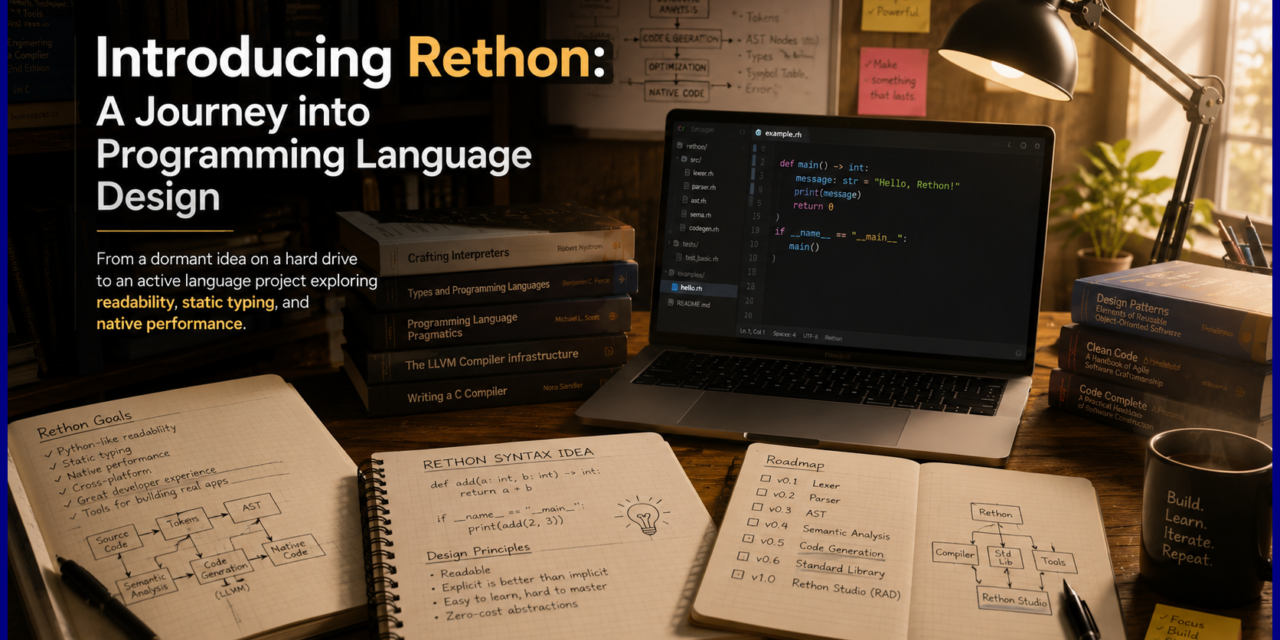
From a dormant idea on a hard drive to an active language project exploring readability, static typing, and native performance.
Programming languages often force developers to choose between readability and performance. Languages that are easy to learn and expressive are frequently interpreted or dynamically typed, while languages that deliver native performance often require more explicit structure and complexity.
Rethon is a personal exploration of the space between those two worlds.
It is an ongoing programming language project centered on a simple question: can a language preserve much of Python’s readability while embracing static typing, Ahead-of-Time (AOT) compilation, and native performance?
Rethon is not being presented as a finished language, nor as a replacement for any existing technology. Instead, it is a long-term effort focused on language design, compiler construction, developer tooling, and ecosystem building.
1. The Story Behind Rethon
1.1. Reticulated Python (2020)
The origins of Rethon can be traced back to around 2020 under an internal project called Reticulated Python.
The original idea was simple: explore whether a language could retain much of Python’s readability while moving toward static typing, native compilation, and stronger compile-time guarantees.
At the time, the project existed primarily as design notes, syntax experiments, architectural sketches, and prototype implementations. It was never intended to compete with existing languages, nor did it progress into a complete compiler project.
However, the idea never completely disappeared.
Even as other projects, professional responsibilities, family commitments, research, and software development work took priority, the concept continued to sit quietly in the background. Every now and then, the same question would resurface:
What would a Python-inspired language designed around static typing and native compilation look like?
Several years later, that question would eventually lead to the creation of Rethon.
1.2. Years on the Hard Drive
Like many personal projects, Reticulated Python spent the next several years sitting quietly on my computer.
The idea never completely disappeared, but life naturally moved in other directions. Professional commitments, family responsibilities, academic pursuits, Gamepenter development, research projects, and numerous software engineering initiatives demanded time and attention.
During those years, the project remained largely dormant. Yet every now and then, the same concept would resurface: a language that could combine much of Python’s readability with the benefits of static typing and native compilation.
The project was never formally abandoned. It simply remained on the shelf, waiting for the right combination of time, experience, and motivation to revisit it.
In hindsight, that pause may have been beneficial. The years that followed brought additional software engineering experience, exposure to large-scale systems, deeper involvement in compiler-related technologies such as LLVM, and a broader understanding of the tradeoffs involved in language and tooling design.
When the project eventually returned, it did so with a clearer direction than it originally had.
1.3. The Birth of Rethon
In 2026, the project was revisited with a renewed sense of purpose and a clearer technical direction.
What had previously existed as a collection of ideas, notes, syntax experiments, and prototype work began to evolve into something more structured. The goal was no longer simply to explore language concepts, but to establish a coherent foundation for a long-term programming language project.
During this period, the project was renamed Rethon.
The new name was derived from the original Reticulated Python concept while providing the language with its own distinct identity. Although the project continues to draw inspiration from Python’s readability and developer-friendly syntax, the intention was never to create a Python clone or a drop-in replacement. Rethon would be free to pursue its own direction, architecture, and design philosophy.
The transition from Reticulated Python to Rethon also marked a shift in approach. Ideas that had previously existed only as scattered notes and experiments were consolidated into documented design principles, language specifications, architecture plans, compiler strategies, and implementation goals.
More importantly, the project moved beyond asking “What if?” and began focusing on “How?”
How should the language be designed?
How should the compiler be structured?
How should LLVM be integrated?
How should interoperability with existing native ecosystems be approached?
Those questions continue to shape the project today and form the foundation upon which Rethon is being built.
2. Why Another Programming Language?
The world already has many excellent programming languages.
Python, C++, Rust, Go, Zig, Swift, Kotlin, Java, and many others continue to solve real problems every day. More recently, projects such as Mojo and Codon have demonstrated that there is still significant interest in exploring the space between Python-like developer productivity and native performance.
Rethon is not being built because the world necessarily needs another programming language.
Nor is it being built under the assumption that existing languages are somehow inadequate. In reality, today’s developers have access to some of the most capable programming languages and tooling ecosystems ever created.
Instead, Rethon exists because programming language design, compiler construction, and software engineering remain fascinating disciplines in their own right.
Building a language forces difficult decisions about syntax, semantics, type systems, tooling, interoperability, performance, developer experience, and long-term maintainability. Every design choice introduces tradeoffs, and understanding those tradeoffs requires far more than simply writing code. It requires thinking about how developers interact with software, how compilers reason about programs, and how ecosystems evolve over time.
Projects such as Mojo and Codon have shown that there is continuing interest in combining Python-inspired syntax with modern compiler technology. Rethon explores a similar area of interest, but from its own perspective and with its own goals, architecture, and design philosophy.
For me, Rethon is ultimately an exploration of language design itself. Whether it eventually grows into a mature language ecosystem or remains a long-term engineering journey, the process of designing, implementing, and learning from it is already valuable.
Sometimes the goal of a project is not simply to build a tool. Sometimes the goal is to understand a discipline more deeply by building one.
3. Why LLVM?
One of the earliest architectural decisions made for Rethon was to build around LLVM.
LLVM is one of the most successful and widely adopted compiler infrastructures ever created. It serves as the foundation for numerous modern languages and toolchains, providing a mature ecosystem for optimization, code generation, and multi-platform support.
Rather than attempting to build an entire compiler backend from scratch, Rethon intends to leverage LLVM’s proven capabilities while focusing development effort on the areas that make the language unique: syntax, semantics, type systems, developer experience, and compiler front-end design.
LLVM offers several significant advantages:
- Mature optimization infrastructure
- Support for multiple CPU architectures
- Native executable generation
- Cross-platform compilation capabilities
- A rich ecosystem of compiler tools
- Proven adoption across industry and academia
- Decades of engineering and performance improvements
Perhaps more importantly, LLVM provides a practical path toward supporting a wide range of platforms without requiring Rethon to maintain separate code generators for each target architecture.
The long-term goal is for Rethon applications to compile into native executables for platforms such as Windows, Linux, macOS, Android, and iOS through LLVM’s existing backend ecosystem.
LLVM also aligns well with one of Rethon’s core objectives: exploring the space between readability and native performance. By leveraging LLVM’s optimization and code generation capabilities, the project can focus on language innovation while standing on the shoulders of one of the most successful compiler projects ever built.
Rethon is not attempting to reinvent decades of compiler engineering. Instead, it aims to build upon that foundation and direct its efforts toward language design, tooling, interoperability, and developer experience.
4. Why Not Just Use Python?
Why not just use Python?
It is a fair question.
Python is one of the most successful programming languages in history. Its readability, simplicity, ecosystem, and developer productivity have made it a dominant force across education, automation, web development, scientific computing, artificial intelligence, data science, and countless other domains.
In many situations, Python is already the right answer.
Rethon is not being built because Python is somehow inadequate, nor is it intended to compete with Python directly. The goal is not to replace Python, rewrite Python, or become a drop-in alternative.
Instead, Rethon explores a different set of tradeoffs.
The project asks whether some of Python’s readability and developer-friendly syntax can be preserved while embracing characteristics more commonly associated with statically typed and compiled languages, including:
- Static typing by default
- Ahead-of-Time (AOT) compilation
- Native executable generation
- Stronger compile-time guarantees
- Compiler-driven tooling
- Predictable deployment artifacts
- Closer integration with native ecosystems
This is not a new area of exploration. Projects such as Mojo and Codon have demonstrated that many developers are interested in combining Python-inspired syntax with modern compiler technologies and native performance.
Rethon explores a similar space, but from its own perspective and with its own architectural goals.
More importantly, the existence of Python is not a reason to stop exploring programming language design. If anything, Python’s success provides valuable lessons worth studying. Understanding why Python became successful is just as important as understanding where alternative design decisions might lead.
In many ways, Rethon is less about replacing Python and more about learning from it.
The project asks a simple but interesting question:
What would a Python-inspired language look like if it were designed from the beginning around static typing, native compilation, and modern compiler infrastructure?
Rethon is one possible attempt at exploring that question.
5. Design Philosophy
Every programming language is shaped by a set of tradeoffs and priorities.
Some languages prioritize absolute performance. Others focus on simplicity, safety, developer productivity, portability, or ecosystem maturity. While no language can optimize for every objective simultaneously, the choices made during language design ultimately determine how the language feels to use and how it evolves over time.
Rethon’s design philosophy is guided by a small number of core principles that influence both the language itself and the surrounding tooling ecosystem.
5.1. Readability First
Readability is one of the primary reasons Python became so successful, and it remains one of the strongest sources of inspiration for Rethon.
Readable code is not merely a cosmetic preference. It directly affects maintainability, collaboration, onboarding, debugging, and long-term project sustainability.
Rethon aims to encourage source code that is easy to read, easy to review, and easy to reason about. The language should help developers understand intent quickly without requiring excessive syntactic noise or unnecessary complexity.
Code is read far more often than it is written, and the language should reflect that reality.
5.2. Static Typing by Default
Rethon is designed as a statically typed language.
Wherever possible, type-related issues should be identified during compilation rather than at runtime. Early detection of errors improves reliability, developer confidence, tooling support, and optimization opportunities.
Static typing also enables richer editor integrations, more precise diagnostics, stronger refactoring capabilities, and improved code navigation.
The goal is not simply to add type annotations, but to make types a first-class part of the language design.
5.3. LLVM First
LLVM is the primary backend strategy for Rethon.
Rather than investing significant effort into building a custom backend and optimizer from scratch, Rethon intends to leverage LLVM’s mature compiler infrastructure for optimization, code generation, and platform support.
This allows development effort to focus on areas that make the language unique, including syntax, semantics, tooling, interoperability, and developer experience.
LLVM is not simply a technical dependency. It is a strategic decision that enables Rethon to build upon one of the most successful compiler ecosystems ever created.
5.4. Native Performance
Rethon is designed around Ahead-of-Time compilation and native executable generation.
The objective is not performance for its own sake, but predictable execution characteristics, simpler deployment models, and closer integration with native software ecosystems.
Compiled native binaries provide opportunities for optimization while reducing dependency on external runtimes and virtual machines.
The language should be capable of scaling from small utilities to larger software systems without fundamentally changing its deployment model.
5.5. Simplicity Over Feature Sprawl
Every new language feature introduces additional complexity.
While it can be tempting to continuously add new syntax, abstractions, and language constructs, doing so often increases the learning curve and implementation burden for both developers and compiler maintainers.
Rethon aims to grow deliberately and thoughtfully.
Features should exist because they solve meaningful problems, not simply because they are fashionable or available in other languages.
The long-term goal is to build a coherent language rather than accumulate a collection of disconnected features.
5.6. Interoperability Over Isolation
Programming languages rarely succeed in isolation.
One of the strengths of modern software development is the ability to leverage existing libraries, frameworks, and tools rather than constantly reinventing them.
Rethon is intended to embrace interoperability with existing native ecosystems, particularly through C and C++ integration.
The goal is not to replace proven libraries, but to make them accessible from Rethon while preserving a productive and readable development experience.
A language becomes significantly more useful when it can participate in a larger ecosystem rather than exist as an isolated island.
6. Python-Inspired, Not Python-Compatible
One of the most important statements about Rethon is:
Rethon is Python-inspired, not Python-compatible.
At first glance, the distinction may appear subtle, but it has significant implications for the language’s design and long-term direction.
Rethon draws inspiration from many of the qualities that made Python successful: readability, simplicity, low syntactic noise, and an approachable developer experience. These characteristics have helped Python become one of the most widely adopted programming languages in the world and continue to influence Rethon’s design philosophy.
However, Rethon is not attempting to become a drop-in replacement for Python, nor is it attempting to achieve full Python language compatibility.
Maintaining complete compatibility with Python would require inheriting many of Python’s historical design decisions, runtime behaviors, and ecosystem constraints. While those decisions make sense within Python’s context, they may not align with Rethon’s goals around static typing, Ahead-of-Time compilation, native executable generation, and compiler-driven tooling.
By not pursuing strict Python compatibility, Rethon gains the freedom to make different architectural decisions in areas such as:
- Type systems
- Compilation models
- Runtime architecture
- Language semantics
- Memory management
- Tooling and diagnostics
- Native interoperability
This approach also allows the language to evolve based on its own requirements rather than being constrained by compatibility obligations.
The goal is not to recreate Python.
The goal is to learn from Python.
Rethon seeks to preserve many of the qualities that developers appreciate about Python while exploring what becomes possible when those ideas are combined with static typing, modern compiler infrastructure, and native code generation.
In many ways, Rethon can be viewed as a language that asks:
What if readability remained a first-class design goal, but the language was designed from the beginning around compilation rather than interpretation?
The answer to that question may not look exactly like Python, and that is entirely intentional.
7. Syntax Direction
One of Rethon’s primary goals is to maintain a syntax that feels familiar, readable, and approachable while remaining explicit enough for modern compiler analysis and tooling.
The language intentionally draws inspiration from Python’s visual simplicity and low syntactic noise. Developers should be able to focus on expressing intent rather than navigating excessive punctuation, boilerplate, or language ceremony.
At the same time, Rethon is designed as a statically typed and compiled language. This means the syntax must provide sufficient information for the compiler to perform semantic analysis, type checking, optimization, and code generation without relying heavily on runtime interpretation.
The current syntax direction emphasizes:
- Readability over brevity
- Explicit typing where beneficial
- Minimal syntactic noise
- Consistent language constructs
- Compiler-friendly structure
- Familiarity for developers coming from Python
For example:
name: str = "Brian"

age: int = 42


def add(a: int, b: int) -> int:

    return a + b


def main() -> int:

    result: int = add(10, 20)

    return 0
Several aspects of this example reflect the language’s design philosophy.
Variable declarations remain concise while preserving explicit type information.
Function signatures clearly communicate parameter and return types.
Indentation continues to play an important role in visual structure, reducing the need for excessive braces or delimiters.
The overall objective is not to replicate Python’s syntax exactly, but to preserve many of the qualities that make Python code approachable and easy to read.
As the language evolves, syntax decisions will continue to be evaluated against a simple question:
Does this improve readability, maintainability, and developer experience without introducing unnecessary complexity?
If the answer is no, the feature likely does not belong in Rethon.
The syntax presented today should be viewed as a direction rather than a final specification. As implementation progresses and practical experience is gained through compiler development, some details may evolve. However, the underlying principle remains constant:
Readable source code should be a language feature, not merely a coding style preference.
8. Type System Direction
A language’s type system plays a significant role in shaping both the developer experience and the compiler’s capabilities.
For Rethon, the goal is not to create the most advanced or academically complex type system possible. Instead, the objective is to build a type system that is predictable, understandable, compiler-friendly, and practical for everyday software development.
The type system should help developers write correct software while providing the compiler with sufficient information to perform validation, optimization, and tooling support.
8.1. Static Typing by Default
Rethon is being designed as a statically typed language.
Wherever possible, type-related issues should be detected during compilation rather than at runtime. This allows many categories of errors to be identified earlier in the development process while enabling richer diagnostics and stronger tooling support.
Static typing also aligns with Rethon’s broader goals around Ahead-of-Time compilation, native executable generation, and compiler-driven developer tools.
8.2. Primitive Types
The initial type system is intentionally small and focused.
Current primitive types include:
- int
- float
- bool
- str
Additional primitive types may be introduced in the future as the language evolves and implementation requirements become clearer.
8.3. Future Areas of Exploration
Several areas are being considered for future versions of the language:
- Generics
- Interfaces
- Nullable Types
- Type Inference
- Collections
- User-defined Types
These features are currently viewed as areas of exploration rather than finalized language commitments.
As with all aspects of Rethon, features should exist because they solve meaningful problems rather than simply because they are available in other languages.
8.4. Balancing Explicitness and Convenience
One of the ongoing challenges in language design is finding the right balance between explicitness and convenience.
Excessive verbosity can reduce readability and developer productivity, while excessive inference can make programs more difficult to understand and reason about.
Rethon aims to strike a balance between these two extremes.
The language should remain explicit enough for both developers and compilers to understand program intent, while reducing unnecessary boilerplate wherever practical.
8.5. Long-Term Goals
The long-term objective is to develop a type system that supports:
- Reliable compile-time validation
- Strong tooling and diagnostics
- Effective optimization opportunities
- Clear and maintainable source code
- Predictable language behavior
Most importantly, the type system should remain approachable.
A powerful type system is valuable, but not if it comes at the cost of readability and developer experience. Consistent with the broader philosophy of the language, Rethon aims to favor clarity over complexity whenever possible.
9. Compiler Architecture
Rethon is being designed as a compiled language built on top of LLVM.
While the language remains in active development, the current architectural direction follows a traditional multi-stage compiler pipeline. Each stage is responsible for transforming source code into increasingly structured representations until native machine code can be generated.
The current architecture direction is illustrated below:

9.1. Lexical Analysis
The lexer is responsible for converting raw source code into a stream of tokens that can be understood by later compiler stages.
Examples of tokens include:
- Identifiers
- Keywords
- Literals
- Operators
- Delimiters
This stage transforms text into a structured representation suitable for parsing.
9.2. Parsing and AST Generation
The parser consumes the token stream and constructs an Abstract Syntax Tree (AST).
The AST represents the syntactic structure of the program while preserving relationships between declarations, expressions, statements, and control flow constructs.
At this stage, the compiler understands how the program is written, but not necessarily whether it is semantically valid.
9.3. Semantic Analysis and Type Checking
Semantic analysis validates the meaning of the program.
This stage is responsible for tasks such as:
- Symbol resolution
- Scope validation
- Type checking
- Function signature validation
- Compile-time diagnostics
The goal is to identify as many errors as possible before code generation begins.
9.4. Rethon Intermediate Representation (RIR)
One of the long-term architectural goals for Rethon is the introduction of a dedicated intermediate representation known as RIR (Rethon Intermediate Representation).
RIR acts as an internal compiler representation between semantic analysis and LLVM IR generation.
By introducing a language-specific intermediate layer, Rethon gains greater flexibility for future optimizations, diagnostics, analysis tools, and backend experimentation without being tightly coupled to LLVM’s internal structures.
In many ways, RIR represents the point at which source code has been fully understood by the compiler and transformed into a language-neutral internal model.
9.5. LLVM Integration
Once RIR has been generated, the compiler produces LLVM Intermediate Representation (LLVM IR).
LLVM then performs optimization, target-specific code generation, and native executable production.
This allows Rethon to leverage decades of compiler engineering while focusing development effort on language design and compiler front-end architecture.
9.6. Why This Architecture?
The objective is not simply to define a language syntax.
The objective is to build a complete language toolchain consisting of:
- Language specification
- Compiler front-end
- Intermediate representations
- LLVM integration
- Runtime support
- Developer tooling
By separating concerns across multiple compiler stages, the architecture remains easier to maintain, evolve, and extend as the language matures.
As with the language itself, the compiler architecture should be viewed as an evolving design rather than a finalized implementation. However, the overall direction reflects the long-term vision currently guiding the project.
10. Native Ecosystem Integration
One of Rethon’s long-term goals is to participate in the broader native software ecosystem rather than exist in isolation.
Many programming languages struggle not because of language design limitations, but because they lack access to a mature ecosystem of libraries, frameworks, and tools. A language may offer elegant syntax, strong performance, and modern features, yet still face adoption challenges if developers are forced to rebuild common functionality from scratch.
For this reason, interoperability is considered a core design objective for Rethon.
Rather than attempting to reinvent decades of software engineering effort, Rethon aims to embrace existing native ecosystems and make them accessible through a modern language experience.
10.1. C Interoperability
Rethon is intended to support interoperability with native C libraries through a Foreign Function Interface (FFI).
The C ecosystem represents one of the largest collections of reusable software components ever created. By supporting C interoperability, Rethon can immediately benefit from mature, battle-tested libraries without requiring complete reimplementation.
Potential integrations include:
- SQLite
- OpenSSL
- libcurl
- SDL
- zlib
- libpng
- libjpeg
The long-term goal is to allow developers to leverage existing C libraries while writing application logic in Rethon.
10.2. C++ Library Integration
Beyond C interoperability, Rethon is also intended to support integration with C++ libraries through interoperability layers and wrapper APIs where appropriate.
C++ remains one of the most important languages in systems programming, game development, computer vision, artificial intelligence, scientific computing, and high-performance software.
Access to the C++ ecosystem opens the possibility of leveraging technologies such as:
Computer Vision
- OpenCV
Artificial Intelligence and Machine Learning
- ONNX Runtime
- TensorFlow Lite
- TensorRT
- XGBoost
- LightGBM
- llama.cpp
- GGML
- GGUF-based inference engines
Compiler and Tooling
- LLVM
- Clang
Desktop Applications
- Qt
- Dear ImGui
Game Development
- SDL3
- Box2D
- Bullet Physics
General-Purpose Libraries
- Boost
- Poco
- fmt
- spdlog
Rather than forcing developers to rewrite mature libraries, Rethon should be able to build upon existing software investments whenever practical.
10.3. Why Interoperability Matters
Programming languages rarely succeed in isolation.
A language’s usefulness is determined not only by its syntax or performance characteristics, but also by the ecosystem it can access.
Interoperability significantly reduces one of the largest barriers facing new languages: the need to rebuild entire software ecosystems from scratch.
Rather than replacing mature technologies such as SQLite, OpenCV, SDL, LLVM, ONNX Runtime, or other proven libraries, Rethon aims to make them accessible through a modern language experience.
This allows the project to focus on language design, compiler technology, tooling, and developer experience while benefiting from decades of proven software engineering work.
10.4. Potential Application Areas
By leveraging existing native ecosystems, Rethon could potentially be applied across a wide range of domains, including:
- Desktop application development
- Computer vision systems
- Artificial intelligence and machine learning
- Game development
- Scientific and engineering software
- Graphics and visualization tools
- Networking and distributed systems
- Data processing pipelines
- Embedded and systems programming
- Developer tools and automation
These examples should not be interpreted as official targets or commitments. Rather, they illustrate the opportunities that become available when a language can effectively participate in existing native ecosystems.
As with the rest of the project, the focus remains on building a solid language foundation first. The application areas that ultimately emerge will depend on how the language, tooling, and ecosystem evolve over time.
11. Current Prototype Status
Although Rethon remains in its early stages, the project has already progressed beyond pure concept, documentation, and language design discussions.
The ideas that eventually became Rethon have been explored through a series of prototype implementations, syntax experiments, compiler investigations, and architectural studies spanning several years. These efforts have provided practical opportunities to validate assumptions, explore implementation approaches, and better understand the challenges involved in building a programming language and compiler ecosystem.
The work carried out so far has included experimentation in areas such as:
- Lexical analysis
- Parsing
- Abstract Syntax Tree (AST) generation
- Type-system exploration
- Compiler architecture design
- Intermediate representation concepts
- LLVM integration research
- Language syntax validation
These experiments have helped shape many of the decisions reflected throughout this document and have reduced a significant amount of technical uncertainty surrounding the project.
While the implementation remains private at the time of writing, the prototype work has served as an important vehicle for validating language concepts and informing architectural decisions. The lessons learned from these experiments continue to influence the direction of the language, compiler architecture, and tooling strategy.
It is important to note that the current prototypes should not be viewed as the final implementation of Rethon. As with many long-term engineering projects, significant evolution is expected as the language specification matures, implementation experience accumulates, and new ideas emerge.
However, the existence of prototype implementations demonstrates that Rethon has already moved beyond the idea stage and into practical engineering exploration.
The current focus remains on refining the language design, validating architectural decisions, documenting the language specification, and establishing a solid foundation upon which future compiler, runtime, and tooling development can be built.
In many ways, the prototypes have already fulfilled one of their most important objectives: transforming Rethon from a collection of ideas into a project grounded in experimentation, implementation, and continuous learning.
12. Long-Term Vision
Rethon has already progressed beyond the idea stage and into active design, experimentation, and prototype development.
The current focus remains on refining the language specification, validating architectural decisions, exploring compiler implementation strategies, and establishing a solid technical foundation for future development.
However, Rethon is not envisioned as merely a programming language syntax or a compiler experiment.
The long-term vision extends beyond the language itself and includes the gradual development of a complete ecosystem capable of supporting real-world software development.
Over time, the project aims to evolve toward providing:
- A stable language specification
- A production-ready compiler
- A runtime library
- Standard libraries
- Package management
- Formatting tools
- Testing frameworks
- Language server support
- IDE integrations
- Documentation and learning resources
- Cross-platform deployment support
The broader objective is to create an environment where developers can move from writing source code to building, testing, packaging, and deploying applications using a coherent set of tools designed around the language.
Beyond tooling, the project also serves as a long-term exploration of programming language design, compiler construction, developer experience, and software engineering practices. As the language evolves, new ideas, lessons learned, and practical implementation experience will continue to influence its direction.
It is important to recognize that these goals represent a long-term vision rather than a short-term promise.
Programming languages and their ecosystems often require years of iteration before reaching maturity. The path forward will depend on continued experimentation, learning, implementation effort, community interest, and the realities of maintaining an ambitious long-term project.
Whether Rethon ultimately grows into a mature language ecosystem or remains a valuable engineering journey, the process of designing, building, and learning from it is already one of the project’s most meaningful outcomes.
13. Roadmap
Rethon has already progressed beyond the conceptual stage and into active experimentation and prototype development.
Several aspects of the language, compiler architecture, and implementation strategy have been explored through prototype implementations and ongoing research. While significant work remains ahead, the project now has a clearer understanding of its technical direction and long-term objectives.
The roadmap presented below reflects the current evolution path of the project rather than a strict sequence of milestones.
Phase 1: Language Refinement and Specification
Much of the foundational language design work is already underway.
Current efforts focus on refining and formalizing the language through:
- Design Principles
- Syntax Specification
- Type System Design
- Language Specification
- Core Language Semantics
- Compiler Architecture Documentation
The objective of this phase is to establish a stable foundation upon which future compiler and tooling development can be built.
Phase 2: Compiler Front-End Maturation
With prototype implementations already validating core concepts, the next stage focuses on strengthening the compiler front-end.
Key areas of development include:
- Lexical Analysis (Lexer)
- Parsing
- Abstract Syntax Tree (AST)
- Semantic Analysis
- Type Checking
- Compiler Diagnostics
The goal is to transform experimental implementations into a more robust and maintainable compiler foundation.
Phase 3: Intermediate Representation and LLVM Integration
Once the front-end architecture matures, development can focus on strengthening the compilation pipeline.
Key objectives include:
- Rethon Intermediate Representation (RIR)
- LLVM IR Generation
- Optimization Research
- Runtime Foundation
- Native Executable Generation
This phase represents an important milestone in the evolution from language prototype to fully compiled language.
Phase 4: Developer Tooling
A language becomes significantly more useful when supported by a productive tooling ecosystem.
Planned areas of development include:
- Package Management
- Code Formatting Tools
- Language Server Support
- VS Code Extension
- Build and Project Tooling
- Documentation Generation
The objective is to improve the overall developer experience and reduce friction when building software with Rethon.
Phase 5: Ecosystem Expansion
Beyond the language and compiler itself, the long-term vision includes the gradual development of a broader ecosystem.
Potential areas of focus include:
- Standard Libraries
- Testing Frameworks
- Native Library Bindings
- Cross-Platform Support
- Documentation and Learning Resources
- Community Infrastructure
As interoperability matures, this phase may also include deeper integration with existing C and C++ ecosystems, enabling developers to leverage proven libraries while writing applications in Rethon.
Looking Ahead
The roadmap outlined above should be viewed as a living document rather than a rigid development plan.
Programming languages evolve through experimentation, implementation experience, and continuous learning. As Rethon matures, priorities may shift, new ideas may emerge, and previously held assumptions may be challenged.
The immediate goal is not to build everything at once.
The immediate goal is to continue transforming Rethon from a promising prototype into a solid language foundation, one step at a time.
14. Final Thoughts
Rethon is still in its formative stages, and there remains a considerable amount of work ahead.
The language specification continues to evolve, the compiler architecture continues to mature, and many of the ideas discussed throughout this article remain subjects of ongoing exploration and refinement. That is the nature of long-term engineering projects, particularly those involving programming language and compiler development.
Yet perhaps the most important milestone has already been achieved.
Rethon is no longer merely an idea.
What began as an internal project called Reticulated Python has gradually evolved into a structured language initiative with documented design principles, a defined architectural direction, prototype implementations, and a growing body of technical documentation.
Whether Rethon ultimately becomes a widely adopted programming language, a niche technical tool, or simply a personal engineering journey remains impossible to predict.
What can be said with confidence is that the project has already proven valuable.
The process of exploring language design, compiler construction, interoperability, developer tooling, and software architecture has provided opportunities to learn, experiment, challenge assumptions, and deepen my understanding of software engineering as a discipline.
In many ways, Rethon is as much about the journey as it is about the destination.
It is an exploration of what can be learned by attempting to build something ambitious, one step at a time.
The road ahead will undoubtedly include successes, mistakes, redesigns, dead ends, and unexpected discoveries. That is not a weakness of the project. It is part of the process.
For now, the goal remains simple:
Continue learning.
Continue building.
Continue refining.
And continue exploring the space between readability and native performance.
Contents
- 1. The Story Behind Rethon
- 2. Why Another Programming Language?
- 3. Why LLVM?
- 4. Why Not Just Use Python?
- 5. Design Philosophy
- 6. Python-Inspired, Not Python-Compatible
- 7. Syntax Direction
- 8. Type System Direction
- 9. Compiler Architecture
- 10. Native Ecosystem Integration
- 11. Current Prototype Status
- 12. Long-Term Vision
- 13. Roadmap
- 14. Final Thoughts